Why Experienced Professionals Struggle in Interviews
You’ve been in your field for 10, 15, or 20 years. You’ve shipped complex systems, built projects on tight budgets, resolved deep team friction, and watched strategic decisions play out over long horizons, learning firsthand what works and what backfires.
Then you step into an interview loop, and the feedback comes back:
“Your answers stayed high-level or general. We struggled to draw out specific examples from your past experience.”
If you’ve received this feedback, it can feel deeply puzzling. You weren’t trying to evade the question; you were sharing the distilled wisdom of a career of real-world work.
Why does this disconnect happen so often to seasoned practitioners? It usually comes down to two main causes: a fundamental misalignment between how experienced professionals communicate wisdom versus how interview rubrics grade it, and a failure to adapt the story for cross-functional interviewers.
1. Earned Insight vs. Storytelling Mechanics
When experienced practitioners talk to each other their go-to approach is not to exchange step-by-step case studies with exact metrics by do that only as evidence if required to make further decisions. Instead, they listen for earned insight: the subtle, second-order nuances that only come from years of hands-on work.
For example, if you ask an experienced professional how they handle technical conflict when team members disagree:
-
A theoretical answer: “I schedule a meeting, weigh the technical trade-offs against business goals, and align the team on a decision.”
-
An earned insight: “Sometimes you just have to step in and make the call. But the critical part isn’t the decision itself; it’s staying close to the folks who disagreed in the weeks following, because that’s where quiet disengagement and churn actually happen.”
You can’t fake that second response. It doesn’t come from a handbook; it comes from making a tough call, watching a key contributor burn out or leave two months later, and adjusting how you operate. To anyone who shares your domain, that insight is immediate proof of real experience.
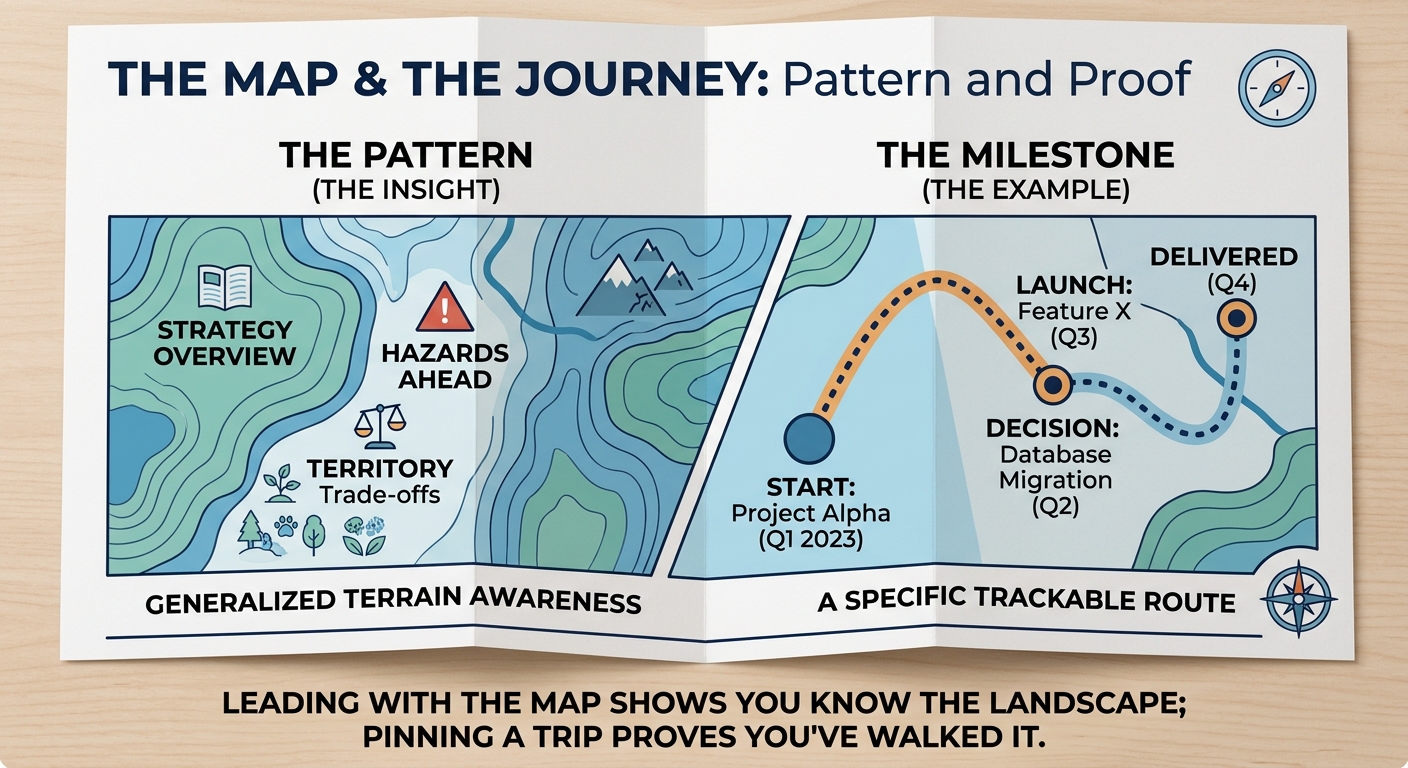
2. The Mental Model: The Map & The Journey
To understand why this disconnect happens, consider The Map vs. The Journey:
-
The Map (Pattern Recognition): Over a career of leading projects and shipping work, your brain builds a comprehensive topological map of your domain. You know where the swamps are, where the hazards hide, and which shortcuts collapse under load.
-
The Journey (The Milestone): A specific historical story (“That time in Q3 2023 when we migrated the system”) is just one single trip you took across that map.
| The Pattern (The Map) | The Milestone (The Journey) |
|---|---|
| Generalized terrain awareness, knowing trade-offs, and identifying hazards. | A specific trackable route, dates, steps, and outcomes. |
When an interviewer asks how you handle a problem, leading with The Map shows that you understand the whole terrain. But standardized interview rubrics are designed to grade The Journey.
3. Top-Down vs. Bottom-Up: Inverse Approaches
This exposes the core conflict between standard corporate frameworks and senior-level communication:
-
The Standard STAR Method (Bottom-Up): Forces you to start at the micro-level, one specific point on the map (Situation/Task), and tell a linear narrative to prove you know how to execute. It asks you to show a single trip to prove you understand navigation.
-
The Map-First Approach (Top-Down): Starts at the macro-level, demonstrating terrain awareness, trade-offs, and second-order hazards, and then zooms in to anchor a specific milestone (“For example, on Project Alpha…”).
| STAR Method (Bottom-Up) | Map-First (Top-Down) |
|---|---|
| 1. Situation (Micro event) | 1. Terrain & Hazards (Macro) |
| 2. Task & Action | 2. Principle & Trade-offs |
| 3. Result & General Lesson | 3. Anchored Milestone (Micro) |
Standardized interviewing treats STAR as the only valid signal. But for senior roles, starting top-down demonstrates strategic foresight, showing you don’t just follow a GPS route, you know the map.
4. The Cross-Functional Blindspot: Multi-Audience Loops
Here is where many senior candidates trip up: an interview loop is almost never made up solely of your peers.
In a typical interview loop, you might talk to:
-
A Senior Engineering Lead (who shares your technical map).
-
A Product Manager or Product Lead (whose map is customer value, scope, and roadmap velocity).
-
A Designer or UX Specialist (whose map is user empathy, research, and collaborative iteration).
-
A Recruiter or HR Partner (whose map is rubric alignment and organizational fit).
When you share an earned insight about deep domain mechanics or team dynamics with a Product Manager or Designer, they do not possess the domain map required to decode it. To them, your high-level insight doesn’t sound like senior wisdom; it sounds like abstract jargon or a vague answer that avoids the question.
5. Owning the Translation: Adapting to the Listener
Effective communication requires empathy for the audience across the table. It is the candidate’s responsibility to translate their map into a frame the listener values:
| Audience | How to Frame the Map & Milestone |
|---|---|
| Product / Business | Frame trade-offs in terms of business risk, release speed, and feature sustainability. |
| Design / Research | Frame trade-offs around team collaboration, user impact, and balancing feasibility with user experience. |
| Peer / Domain Lead | Frame trade-offs around deep technical patterns, team dynamics, second-order consequences, and debt. |
6. Bridging the Gap: The Map-First Anchor
You don’t need to abandon your hard-won principles or force yourself into a canned STAR script. You simply need to package your answers top-down: Lead with the Map, then anchor with a Milestone.
Step 1: Show the Map (The Insight)
Start with your high-level principle and the subtle hazards behind it.
”In my experience, when product and engineering disagree on timelines, the real risk isn’t missing a delivery date; it’s that engineering takes on tech debt in secret to make it look like things are fine.”
Step 2: Pin the Milestone (The Anchor)
Immediately follow up with a brief, real-world trip that illustrates that map location in action.
”For instance, at my last company, our PM wanted to rush an auth feature while the dev team warned of system instability. I ran a joint discovery session where we split the release into two phases, giving us 1 week to refactor core auth while still delivering 80% of the product scope on time.”
Final Thoughts
Interviewing is a specialized communication exercise. Being labeled as “too general” rarely means you lack experience; more often, it means your distilled wisdom needs to be anchored to a clear milestone and translated for the person sitting across from you.
Leading with the map proves you know the landscape. Pinning a trip proves you’ve walked it. Translating it for your interviewer proves you can communicate effectively across an entire organization.