Effective Interviewing (Part 3): The Ceiling is set by the Interviewer
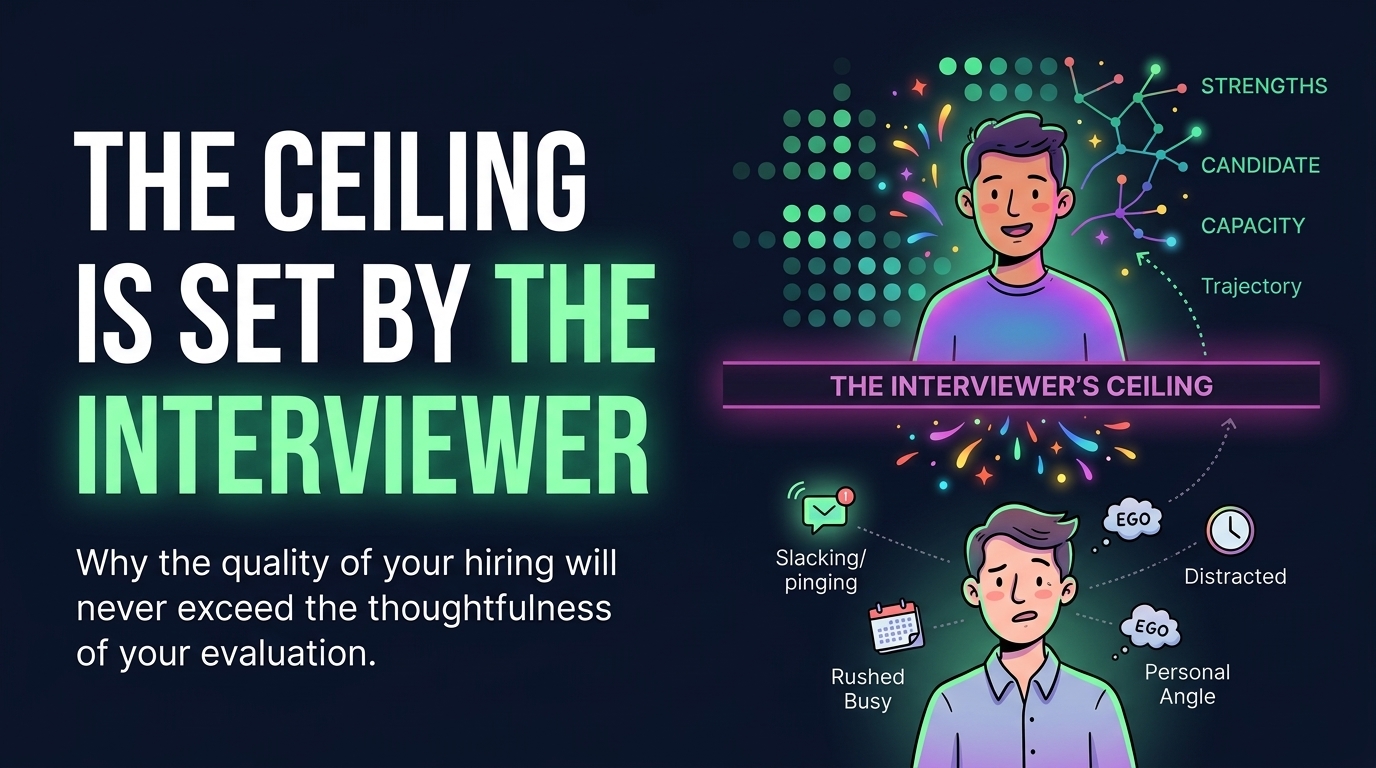
Most interview advice focuses entirely on the candidate, helping them to prepare, how to answer tricky questions, and how to position your experience. But this overlooks a fundamental operational reality: An interview only goes as well as the interviewer allows it to.
When an interview falls flat, the default corporate reflex is often to blame the candidate. But the ceiling of any interview is strictly set by the interviewer. You can have a brilliant professional sitting across the table, but if the interviewer brings a rushed mindset, an unclear scenario, or a distracted presence, that candidate will never get the space to shine. Of course, there is no rule without an exception and a charismatic interviewee can turn the situation around.
However, raising the quality of your hiring doesn’t start with demanding more from the candidate; it starts with improving how you show up in the room. Below are four fundamental notions for conducting an interview that brings out the best in people.
1. Hunt for Strengths, Not “Gotchas”
Finding weaknesses is the easiest thing in the world. Anyone can trip up a candidate if they dig into obscure trivia, construct overly complex artificial puzzles, or look for an excuse to say no. But an interview isn’t a pop quiz or an elimination round; it is an evaluation of potential.
When you focus solely on what a candidate doesn’t know, you miss the point entirely. The goal is not to find a walking encyclopedia who matches your exact background down to the letter; it is to discover what they do know and how they actually work when confronted with a novel problem.
When you hit a knowledge gap, which is inevitable; do not write them off as unqualified. Instead, test their trajectory. Do they have the curiosity, foundational logic, and are capable enough in order to bridge the knowledge gap through skill? A brilliant mind with a minor, easily fixable knowledge gap will always outperform a mediocre mind armed with a rigid, memorized script. Stop looking for gotchas and start looking for what they actually bring to the table.
2. Leave Your Ego Aside and Focus on What They Add
Many interviewers fall into limiting patterns without realizing it. It’s rarely about active posturing or aggressive ego; rather, it’s a quiet, subconscious reflex. People sometimes hesitate to bring in someone exceptional because of how it might shift the team dynamic, or they default to seeing things strictly through the lens of their own past experiences and preferences.
You must be prepared to be humbled. Be genuinely open to the reality that a candidate might take a completely different, highly effective approach to a problem that you hadn’t considered. An interview shouldn’t be about measuring them against your ego, your preferred methodology, or your specific situation.
As we mentioned in point 1, the interview’s goal should be the objective exploration of what this person could bring to the team, how their different perspective can shed light to the team’s blind spots and how they can help towards the goals, even if this is a challenge on yourself.
3. Assume Naivety, Not Lack of Knowledge
In a situation in which a candidate stumbles over a question or provides an answer which seems unexpected, the default reaction should not be to assume they lack depth, skill or understanding.
Instead, adopt the assumption of naivety. Go into the exchange with the notion that they simply did not understand the framing, or that your question was ambiguous. When a misunderstanding happens, your job is to help them bridge the gap: explain the context better, reevaluate the scenario you provided, and guide them through it.
By assuming that they just needed a clearer angle rather than moving to the next topic, you immediately create a moment that allows problem-solving collaboration to emerge. Giving them the space to work towards the answer you expected. This approach actively reveals how a candidate handles feedback, their ability to process new information and their collaborative skills in a timed interview which reflects their work style during high pressure situations.
4. Be Present, On Time, and Respect Their Time
Interviewers are busy, you hop on a call and your slack does not stop, projects keep being important and deadlines get ever closer. With all these over your head it is only normal for the pressure to leak into the interview.
However, it is important to remember that conducting this interview is at the moment your primary job, it is part of your job description and you are there to perform a rigorous but fair evaluation of the candidate.
This stems from two perspectives: you are getting paid to do this, whilst the candidate might had to juggle their schedule for this opportunity. The most important thing though is mutual respect. By fully engaging in the interview you are giving the candidate the respect they deserve as a fellow human and potentially a fellow coworker in the future.
Being fully attentive apart from being a matter of basic politeness, it is also an absolute operational necessity. When you are being half-distracted, checking a screen, messages or thinking about your next meeting, the candidate can perceive this immediately. This creates an unfair cognitive burden: the candidate ends up splitting their mental bandwidth, trying to figure out how to regain your attention instead of focusing entirely on the problem at hand. When you give them your full presence, you stabilize the room, lower unnecessary anxiety, and allow them to perform at their true capability.
The Interviewer Sets the Ceiling
An interview is a two-way reflection. It doesn’t just evaluate the candidate’s capabilities; it reveals the maturity, discipline, and thoughtfulness of the team conducting it.
If your interview process relies on confusing prompts, distracted listening, or rigid expectations, you will miss out on great people. Remember that an interview goes only as well as the interviewer allows it to. When you set the right environment, clear the path, and stay fully engaged, you give great candidates the room they need to truly shine.