Culture or Crutch? What Your Office Mandate Actually Says About Your Leadership
The debate around returning to the office often gets bogged down in surface-level arguments about coffee machines, watercooler serendipity, and productivity metrics. But if you strip away the corporate PR, a much starker reality emerges: the rigid insistence on mandatory on-site working is rarely about the work itself. Instead, it is an admission of failure in two critical areas—organizational structure and management capability.
When companies mandate physical presence, they are usually trying to patch over deeper cracks in how they communicate, how they structure their teams, and how they manage trust.
Part 1: Communication as a Symptom of Poor Structure
When leadership argues that teams must be in the office to collaborate effectively, they are usually diagnosing a symptom while misdiagnosing the disease.
Bad communication in an organization isn’t about people failing to speak clearly; it is a structural failure. If an organization lacks a clear structure, for example, if roles, responsibilities, and ownership lines are murky, then naturally communication breaks down. To compensate, companies introduce the concept of “overcommunication”, demanding constant meetings, synchronous alignment, and instant responses, suggesting it is a healthy approach.
Furthermore, many organizations pride themselves on being “fast-paced” or “agile.” Of course, there are environments such as early-stage startups or genuine 0-to-1 product discovery, where the nature of the work truly demands rapid, undefined iteration, and physical proximity makes complete sense. In most established companies however, “agile” simply serves as corporate speech for continuous change with chaotic elements. When priorities shift by the hour without discipline, information cannot travel through formal documentation or asynchronous channels fast enough. It requires maximum proximity between the involved members in order to simply keep everyone from working in alignment.
To be clear, this is not inherently a bad choice. An organization can choose to operate in a perpetual state of high-velocity chaos where everything changes on a dime, and physical proximity is the only way to glue it together. But outside of true 0-to-1 invention, if that same organization invested in proper structural scaffolding: fleshing out clear ownership, predictable processes, and robust documentation; the desperate need for hyper-fast, on-site communication would largely evaporate. Relying on physical presence to bridge structural gaps is a sign of poor organizational design.
Part 2: Micromanagement, Trust, and the Remote Work Pendulum
The second major driver behind on-site mandates is weak leadership exposing itself through low-trust and micromanagement.
The impulse to micromanage typically stems from two distinct directions:
- Top-Down Control: Traditional management styles rooted in distrust. Some leaders simply possess a deep-seated need for control and power, operating from the default assumption that if they cannot physically see you, you aren’t working.
- Bottom-Up System Abuse: The unintended vacuum created through high trust environment with low structure which is abused by employees to cater purely to their needs and not their job, which was exacerbated by the hastily adopted remote work during the COVID era.
To understand how we got here, we have to look at the fatal combination of remote work and completely unanchored, flexible working hours.
Extreme flexible working environment in which everyone works whenever they please with the precedence of an outcome based setup, can only survive in two environments: companies with immaculate, hyper-structured documentation or in workflows dominated by isolated individual contributors. In any standard collaborative organization the removal of core working hours is catastrophic. If teams operate for example six hours apart, you introduce a permanent six-hour lag into every basic interaction. Which is not to say that it cannot work, but not on its own without structure. Standardizing absurd policies like 24 hours response times for internal messaging does not create freedom; it puts a weight on operational velocity. Combining weak organizational structure with fully flexible hours is arguably one of the worst systems a business can design. Alas, one is a consequence of the other.
Driven by labor shortages, companies threw out basic operational guardrails and offered this extreme flexibility anyway. Without clear core working hours or boundaries, a vacuum was created, which was quickly abused. The culture of “day in the life of a Project Manager” videos that went viral in the past, showcased the abuse of this broken model by having the employees film themselves running personal errands or drinking coffee during working hours.
The organization failed to create a sustainable remote framework with schedules and accountability, which got quickly abused by employees out of pure inertia towards it. In response leadership panicked and tried to mitigate it through micromanagement and physical mandates. In no way or form should this have been abused, but, in addition, organizations should have exercised structure over rigidity.
Part 3: The Operational Spectrum (Choice vs. Necessity)
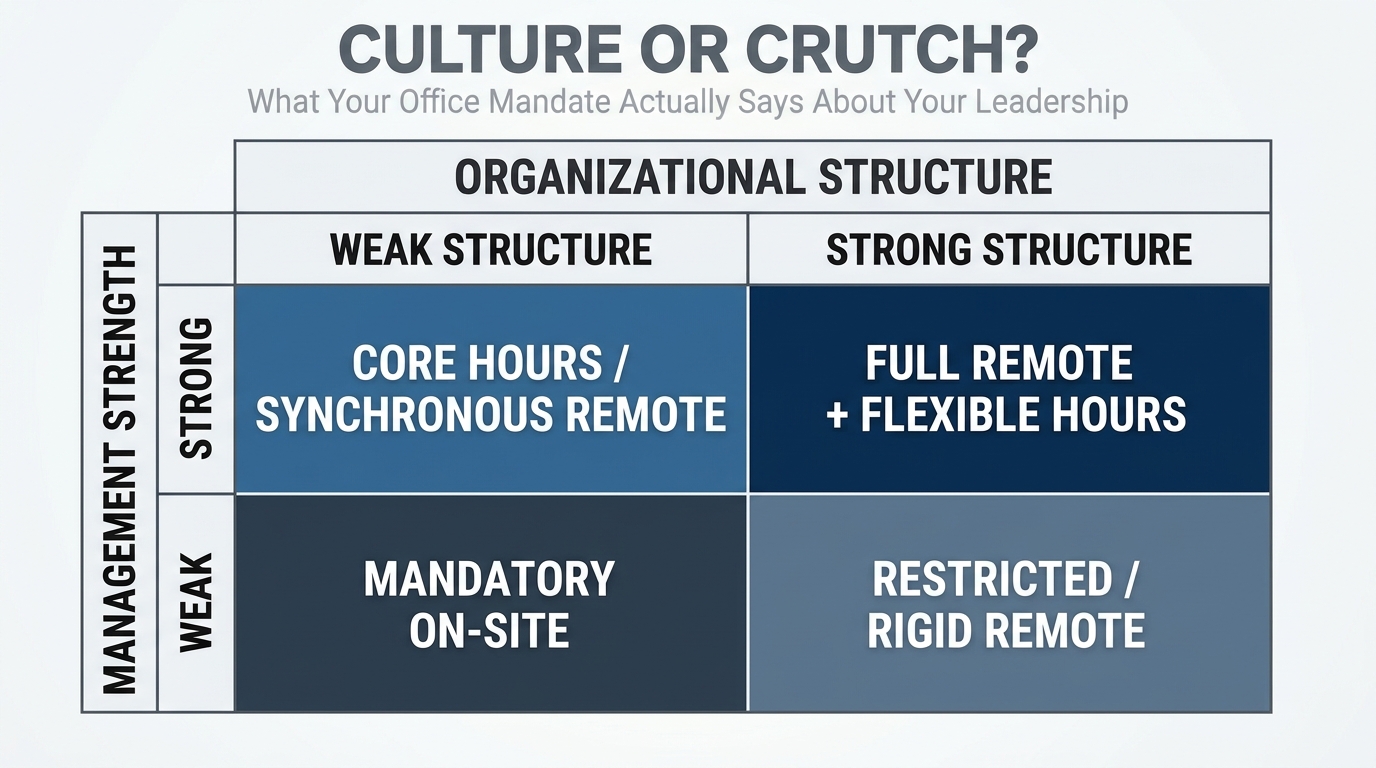
If you map out how organizations operate, a clear formula emerges: remote work and flexible schedules are earned capabilities, not default settings.
| Organizational Foundation | Resulting Work Model | Why It Happens |
|---|---|---|
| High Structure + High Management | Full Remote + Flexible Hours Unlocked | Clear ownership, strong documentation, and real accountability allow teams to operate seamlessly anywhere. |
| High Structure + Weak Management | Restricted / Rigid Remote | The processes exist, but a lack of leadership trust or boundary-setting forces rigid oversight. |
| Weak Structure + High Management | Core Hours / Synchronous Remote | Strong managers can compensate with tight coordination, but extreme flexibility collapses due to communication lag. |
| Weak Structure + Weak Management | Mandatory On-Site | Without structure or leadership guardrails, physical proximity becomes the only way to prevent total paralysis. |
Building and maintaining that top tier of high structure and strong management isn’t magic, it requires a high ratio of seniority. You need experienced leaders and senior individual contributors to architect the documentation, set the standards, and maintain the system; once that foundation exists, junior talent can be smoothly absorbed and mentored within it.
It is also critical not to confuse remote work with “no meetings.” Operating remotely does not mean isolating people behind tickets and cutting off synchronous dialogue. Teams still hold meetings, brainstorm, and share nuanced context. They simply do it deliberately over calls rather than relying on accidental desk-side interruptions.
When an organization achieves high structure and strong management, remote work and flexible hours naturally converge. The moment either pillar drops, your operational ceiling drops with it; forcing you back toward rigid schedules and physical proximity just to keep the wheels turning.
The Real Value of the Office: Culture, Not Crutch
This doesn’t mean the physical office has zero value. There are undeniable positives to being on-site: spontaneous brainstorming, organic mentorship, building genuine human connections, and fostering a shared company identity.
The critical distinction is why you are in the office.
When a company has strong structure and capable management, bringing people together on-site is a cultural choice. You gather in person to build relationships, celebrate wins, and enjoy the social energy of a shared space, not because the business will break if people sit ten miles apart.
When a company lacks those foundations, the office becomes a structural crutch.
Mandating on-site work is cheap. It allows leadership to treat the surface-level wound of poor communication and broken trust without fixing the underlying disease. Until companies are willing to invest in real structural scaffolding, clear core hours, and mature management, the push for the office will remain what it truly is: a band-aid for bad leadership.